Pimcore series: PIM - why do you need it and why do you need it now?
Summary
Product information management (PIM) gives teams a place to prepare and approve the product details they publish. A spreadsheet or an ecommerce platform can be enough when one team maintains a stable assortment for a single store. Consider PIM when a change to one product means editing several listings, checking which translation is current or asking a designer to correct a catalog by hand. A useful first step is to follow one recent change from its source to every place customers saw it. Where did someone have to enter or verify the same information twice?
What does PIM do?
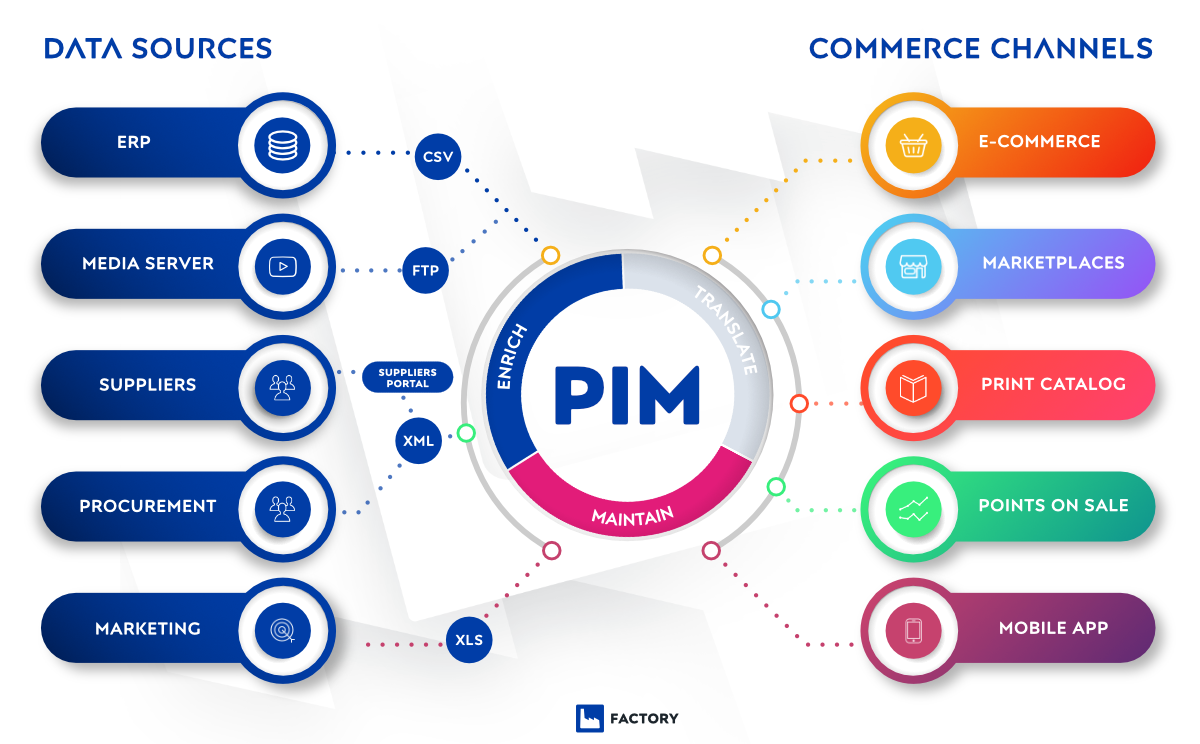
The term product information management (PIM) describes how a business collects, organizes and maintains the information it uses to describe and sell its products. A PIM system gives product specialists, marketers and editors a shared record where they can prepare that information for publication.
What type of information can PIM manage?
- Technical information helps buyers decide whether a product fits their requirements. For a machine, this might include motor power, dimensions and compatible accessories.
- Emotional information includes the photography, stories and descriptions that help buyers picture a product in use.
- Usage information explains how to install, operate or care for the product. It can include instructions on the product page and a link to the manual for that model.
When does managing product data become difficult?
A missing measurement is easy to fix when the person who knows it also edits the only product page. The same correction takes more coordination when engineering supplies the value, marketing writes the description and a local team approves the translation. The difficulty is knowing which parts are ready and who can resolve what is missing.
Take a machine sold in two countries. Its model number can stay the same while its description changes with the language. In Pimcore, editors can maintain those descriptions in localized fields on one product record. A manual needs a different check: someone has to confirm that the file belongs to the right model, version and market. Linking that file to the product gives the next editor a way to find it again.
Why is PIM so hot now?
What are the main reasons the companies are embracing PIM? Let’s name a few!
Data Quality
No matter the complexity of your product data quality management, Pimcore’s product information management software provides you with clean and trusted data with enterprise-class quality and governance to help you scale faster.
Pimcore PIM platform features many functionalities for defining and improving data quality and data completeness. Also, there are data validation and data quality reports which you can analyze and use them to monitor data quality.
Pimcore features custom reports which are easily integrated with Pimcore’s PIM platform. The custom reports generate reports such as – data completeness report, quality report, and many others.
Also, PIM comes with several user-specific dashboards that are easy to adjust and configure, depending on your needs. On these dashboards, you’ll find relevant information for your business, important states, and some specific workflows. It mainly focuses on data.
Altogether, Pimcore nails down data quality management. It provides you with a clear overview of your data quality and data completeness and enables you to scale your business fast!
Effortless workflow management – tailoring workflows to your needs

Pimcore product information management software functions also as a workflow management software. It enables companies to create and alter workflows according to their needs while boosting productivity and minimizing risks.
PIM platform comes with an advanced workflow engine that defines business processes and editorial workflows. It has the ability to create the most complex workflow scenarios, meaning it’s fully adaptable to enterprises that have many different departments, actions, and levels of approval.
One of the main benefits of PIM workflow management is the improvement of team collaboration. Simply put, PIM unifies your product data while workflow unifies the users of that PIM.
Reliable data management – efficient and accurate data handling

If you’re managing the business process or gathering business intelligence, efficient enterprise data management is a must-have for you.
Pimcore is deeply focused on the user-friendly and consistent organization, aggregation, classification, and translation of rich product information. It enables you to manage every aspect of each record, including hierarchy, structure, validations, versioning, and other related data in the data editing interface.
PIM seamlessly integrates with DAM – digital asset management system. DAM is another Pimcore product, ideal for managing media files and documents, or plainly said, all digital assets.

All of the Pimcore products are connected and can be used simultaneously, creating a synergistic effect, but also can function independently. That’s the true power of Pimcore – it enables you to utilize every aspect of your business to the maximum.
Pimcore goes beyond that. It shifts away from content management to digital experience platform.
So, what would that mean? It means that it has the ability to provide highly adaptable, targeted, and dynamic digital experiences for every customer. Recently, digital experience has become a new buzzword in the online business world and it’s not by accident!
We’ve covered the benefits of Pimcore DXP in one of our previous blogs – so don’t hesitate and take a look at our blog! We’re sure that we can provide you and your business with value!
Use PIM to take your business to the next level
Products are the core of your business. According to that, it makes sense to provide your customers with the most accurate and complete product information.
Without accurate product information and high-quality product experience, there can be no great customer experience!
Besides providing the customers with awesome customer experience, what are the other benefits for the business?
Glad you asked!
We’ll point out 3 key benefits of implementing PIM:

- Escaping/eliminating data silos
- Decreasing time-to-market
- Enabling your business for omnichannel
Now let’s see what all of that means. At first glance, it sounds very promising so let’s inspect it more thoroughly.
Escaping data silos

What are data silos and how to get rid of them? We did previously write on that topic, but let’s go through it once again!
So, what is a data silo? It’s a repository of fixed data that that remains under the control of one of the departments. Usually, that repository is isolated from the rest of the organization.
Suppose a product specialist corrects a specification after sending a spreadsheet to a catalog designer. The specialist sees the correction, but the designer can still publish the old value. A shared product record gives both people a place to find the change. An approval step tells the designer which version is ready to use.
At Plodine, product data from the ERP is checked and approved in Pimcore for each weekly promotion. Designers can then use those approved details directly in Adobe InDesign. The link between the reviewed data and the layout is what makes the shared record useful when a catalog goes to print.
Are there any more benefits of product information management? Yes, let’s continue!
Decreasing time-to-market
Today, customers are at the centre of everything! Their needs and expectations are continuously changing. Therefore, to stay one step ahead of the competition with higher customer satisfaction and positive brand image, technologies and processes have to adapt to this trend.
With Pimcore as an open-source product information management platform, you can automate the creation of unique product information. That can bring you closer to meeting the requirements of multi-channel selling while maintaining a high level of customer experience.
This results in improved time-to-market of new products and reduced overall cost over time.
As the number of product data sources increases with time, it becomes harder to manage all of the product information. Pimcore PIM platform enables you to optimize performance and streamline life cycle management of product data – from one single point of control.
Open-source product information management software, such as Pimcore, provides you with flexibility, speed and agility and better cost-effectiveness of your online business. You can adapt to every need and expectation of your customer quickly and start your way as an omnichannel business.
Omnichannel enablement is also one of the key benefits of Pimcore product information management software. In today’s market, it’s the only way the business can progress quickly and continuously.
Omnichannel enablement – the future of online business

We’ve spoken about omnichannel on few occasions already, about it being a future version of retail and about digital transformation and living examples of omnichannel businesses.
Today, if you wish to succeed online – you must be able to go omnichannel.
What would that mean?
It means that you need to be everywhere! To not leave you confused, we will explain it shortly.
Omnichannel is a cross-channel content strategy used to improve customer experience. All of the communication channels are designed and orchestrated to cooperate.
That means that every customer is going to have a chance to have the same experience through several communication channels – for example, Facebook, retail store and website are types of communication channels.
The key of omnichannel is to get the same message to the same customer on several channels.
Okay, but how does Pimcore product information management software enable omnichannel in the beginning? How is it done?
Let’s take a look:
Eliminate Silos
We already mentioned data silos a while ago. To eliminate data silos, Pimcore’s PIM solution consolidates product information for various data sources. It organizes and prepares channel-neutral product information.
Therefore, all of the content is being prepared to be delivered across web, mobile, social media, in-store or via some other channel to provide the customer with a seamless omnichannel experience.
Multichannel marketing agility
When a product specification changes, the marketing team can update the shared record and reuse the new value wherever it publishes that product. A webshop might use motor power as a search filter, while a distributor needs the same figure in a column called “Rated power”. With Pimcore Datahub’s File Export adapter, the team can map the existing field to the distributor’s column name. Once that mapping is in place, the next export uses the updated figure without anyone having to re-enter it.
For manufacturers that sell through several distributors, an industry network can also help them share updates across sales channels. ABB Electrification, for example, uses IDEA Connector to make enriched product information available to its authorized electrical distributors.
Seamless customer experience
The best thing about Pimcore PIM software. It’s robust APIs enable you to synchronize your inventory between online and physical stores with integrated customer data. You will have the grasp on all of the customers’ needs and wants instantly!
Using Pimcore, you can stand out as an excellent omnichannel business by implementing IoT, point-of-sale, kiosks, wearables, mobile phones, tablets… Every piece of technology can be used to provide your customers with awesome customer experience.
Successful companies have already implemented PIM
There are many examples of successful companies which have their business running on Pimcore. Many huge companies have recognized the importance of omnichannel enablement and management of product information. How well did they do?
Let’s take a look at some businesses!
How did the fastest-growing European car brand implement PIM?
Harald A. Møller is Norway’s largest car importer – it’s responsible for importing Volkswagen, Škoda, Audi and SEAT in Norway.
Møller relaunched SEAT in Norway in 2018 – aiming for younger customers and looking to rebrand SEAT as a young and modern car brand. The fact which supports this aim states that the average SEAT customer is 10 years younger than the average new car customer.
This drives SEAT to decide on exploring new and innovative ways of advertising. They heavily invested in digital experience and made a new SEAT just a few clicks away from its new owner!
Thanks to the new Pimcore PIM solution, ordering a test drive and reserving a car is simplified and can be made directly on the website.
They also simplified the purchasing process greatly. In just a few clicks you can buy a new SEAT and the delivery time on the majority of the models is just – 6 days!
This solution comes with several additional services that make owning a SEAT attractive as it gets! Such services include carpooling or to be more precise – being able to earn money through carpooling. They successfully found their customer’s pain points and emphasized on what can they do to solve their issues!
Online shoe retailer makes a step forward to meet its growing demands
Shoes.com is an online retailer of apparel and footwear, founded in 1996 in Vancouver.
The business was growing quickly and they needed a more efficient way of publishing and distributing their content. Up until their transfer to Pimcore and leveraging of PIM product – they used a combination of two platforms, Shopify eCommerce and a custom PHP application.
What were their needs?
To simplify their publishing process, they needed to establish a single unified data model in one place with all the product information included, such as descriptions, prices and so on.
In essence, they needed a completely new product information system – a single consolidated system with the possibility of integrating with other systems.
To solve their issues, they have been advised to use the power of Pimcore PIM product.
About 30 fields of core attributes were needed to be migrated from the existing two platforms into Pimcore, including 3 million records along with the core attributes.
After the implementation of Pimcore platform, Shoes.com now completes up to 6000 updates every hour! All of the product information can be updated in only a few seconds!
Thanks to these consistent updates, customers now have accurate information on products and offers – everything needed to make a purchase!
Shoes.com does an amazing job thanks to Pimcore! It’s efficiency served the retailer the best way possible.
Next example of a successful online business may be dear to some football fans – so don’t stop here!
Famous German football club takes its eCommerce to the next level
The famous Bundesliga club, Bayer 04 Leverkusen, wanted to level up their eCommerce shop by putting their fans in focus. To bring their shop up to new heights, they needed to pay more attention to performance, availability and cross-channel commerce.
They wanted to exchange their existing eCommerce solution for a new, centralized one. The main focus was placed on better customer targeting, performance stability and the omnichannel enablement.
All departments are needed to work together efficiently, especially when football seasons start, as that is when the customer orders begin to surge.
With the new Pimcore solution, Bayer 04 Leverkusen has differentiated itself from its competitors and now has one of the best eCommerce shops in the niche.
After almost one and a half year of designing and developing, the new shop was ready to go live!
Pimcore’s open-source platform offered a wide variety of functionalities that mostly matched the requirements. Fans were able to choose from several different categories, such as merchandise, gift coupons, football boots and memberships – all via the same platform!
Here you can see that Pimcore can heavily impact the performance of an eCommerce store. If you want to know more about what Pimcore can do for your eCommerce – visit one of our previous articles where we analyzed the functionalities of Pimcore as an eCommerce solution!
Pimcore solution showed high stability. After the announcement and release of a special jersey made for 40th anniversary of the Bundesliga – the website traffic was unusually high. Despite that, the shop remained stable and Pimcore once again proved it’s strength. Fans had a seamless customer experience and ordered their limited jerseys without any issues.
The campaign was a huge success!
Currently, Bayer Leverkusen is still working on improving their platform. They want to accelerate future optimizations and improve the overall shopping experience for the fans which is high-likely to bear fruit in the near future!
Keep this in mind – eCommerce is not the future anymore, that’s the present of modern business and you need to adapt to your customers’ needs! It has a vast array of benefits for both businesses and customers so don’t miss out on this one!
To stay on track and find out more information on eCommerce, we have carefully curated the 10 e-commerce blogs we think you should follow!
How can I implement PIM in my business?
Choose one product that regularly takes too long to publish. Bring its supplier file, the finished listing and one recent correction to a working session. Follow the correction through each handoff. If the problem is an unclear owner, assigning one may be enough. If the same approved value has to be entered and checked again for every channel, test whether a PIM workflow can remove those repeated steps.
Give potential implementation partners that same example. Ask them to show how a product specialist would correct the value, how an editor would approve it and how a distributor would receive it. For an existing PIM, ask the partner to trace the last failed update before estimating changes. For a new implementation, ask for migration, integrations and testing to be priced separately, and establish who would handle upgrades and recovery under each hosting option.